Explore this article · 9 sections
The five daily prayers can act as anchors for a workout routine. Instead of searching for a perfect free hour, attach a realistic workout to a prayer window that already exists in your day.
Choose the right prayer window
Prayer times move with the sun, season, and location, so a schedule should use windows rather than fixed clock times.
| Window | Often works for | Main tradeoff |
|---|---|---|
| After Fajr | Quiet home workout or walk | Sleep may suffer if bedtime is late |
| Before Dhuhr | Lunch-break workout | Work and travel can interrupt |
| After Dhuhr | Short gym session | May be difficult during work hours |
| After Asr | Strength or group workout | Energy and family duties vary |
| After Maghrib | Short home workout | Meal timing and a narrow prayer window matter |
| After Isha | Full gym workout | A hard late session may delay sleep |
Pick the window that creates the fewest conflicts. Protecting sleep is more useful than forcing an early workout because poor recovery makes consistency harder.
Start with two anchor workouts
Adults are generally advised to complete muscle-strengthening activity on at least two days each week, alongside regular aerobic activity (U.S. physical activity guidelines). A simple starting week might look like this:
| Day | Prayer anchor | Plan |
|---|---|---|
| Monday | After Asr | 35-minute full-body strength workout |
| Thursday | After Asr | 35-minute full-body strength workout |
| Tuesday and Saturday | After Fajr or Maghrib | 20-minute brisk walk |
| Other days | After any prayer | Five minutes of mobility if helpful |
The prayer is the cue, not a deadline. If a prayer time shifts or a duty appears, move the workout to another window.
Use three workout sizes
A routine survives busy weeks when it has more than one valid version.
- Full version, 35 minutes: squat, push, pull, hinge, and carry or core work.
- Short version, 15 minutes: one set of four full-body exercises, repeated two or three times.
- Minimum version, 5 minutes: chair squats, incline push-ups, and a brisk walk in place.
The minimum version is not punishment and does not replace every full workout. It protects the habit on unusually difficult days.
Plan for wudu, clothing, and travel
If you expect to pray at the gym, check for a clean space and plan how you will make wudu. Carry a small prayer garment or clean layer if needed. Leave enough time to cool down and change so the workout does not turn prayer into a rush.
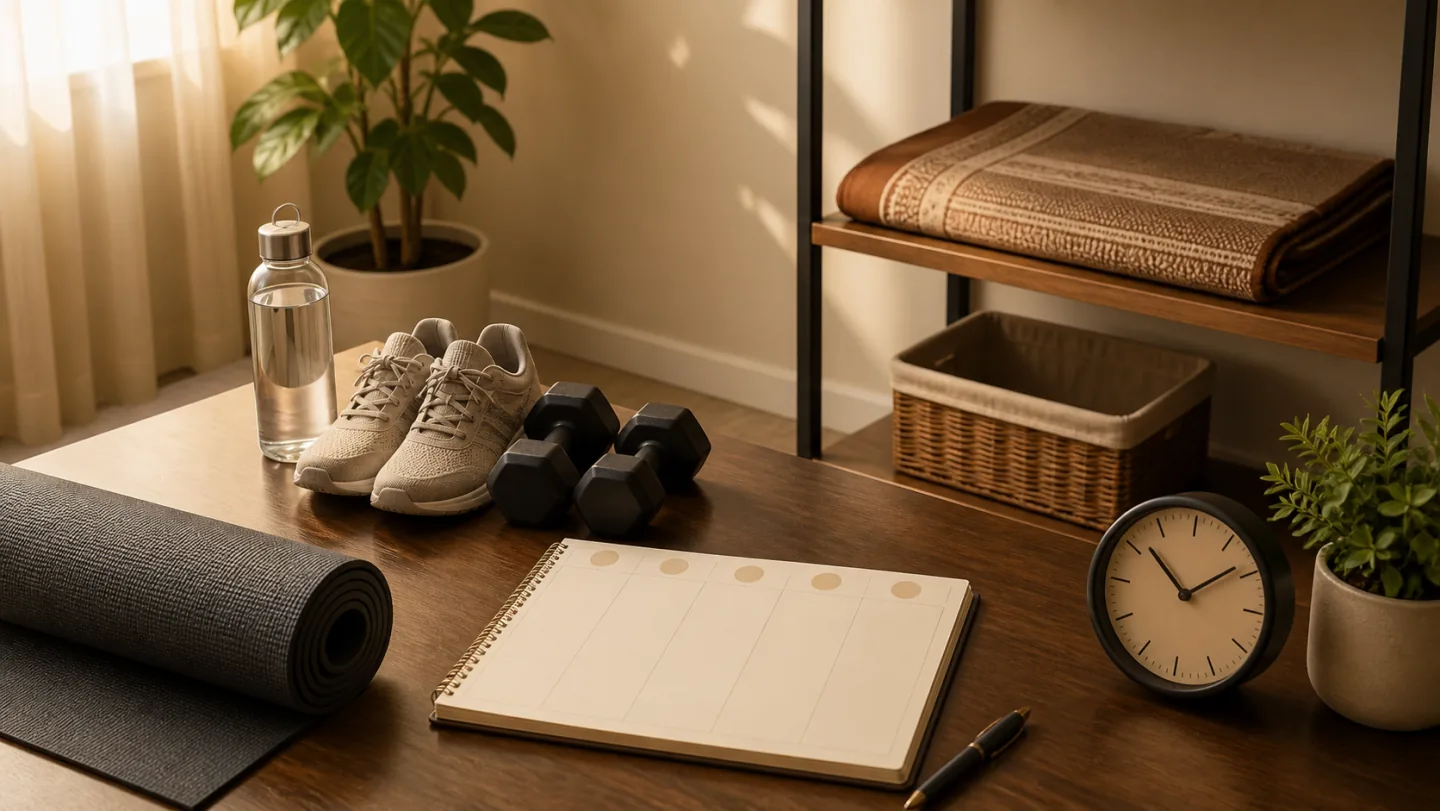
For a home workout after prayer, place a resistance band or shoes where you will see them. The cue should make the next action easy.
What if you miss the planned time?
Use a replacement rule written in advance: “If I miss my after-Asr workout, I will do the short version after Isha or move the full workout to tomorrow.” This prevents one disruption from becoming a lost week.
Do not stack several missed hard workouts into one day. Resume the normal schedule and focus on the next repeatable action.
A seven-day planning card
Write these five answers:
- My two strength days are ___ and ___.
- My normal prayer anchor is ___.
- My backup prayer window is ___.
- My short workout contains ___.
- The person I will tell about my plan is ___.
How Rizanah helps
Rizanah lets you keep a clear workout plan while deciding when it belongs in your actual day. Schedule the full workout in your preferred prayer window, then use an easier or shorter version when work, family, travel, or changing prayer times affect the plan.
The goal is not to make an app control worship. Rizanah holds the exercises and progress in one place, while your local prayer timetable and responsibilities continue to control the schedule.
Frequently asked questions
Is it disrespectful to work out near prayer time?
This article does not issue religious rulings. Leave enough time to pray properly, and ask a qualified scholar about a concern specific to your circumstances.
Is morning or evening better?
The better time is usually the one you can repeat without harming sleep, work, prayer, or family responsibilities. Performance differences matter less than consistency for most recreational lifters.
What about Friday prayer?
Build Friday around your obligations and local prayer time. Moving a workout to Thursday or Saturday is completely reasonable.
The main idea
Use prayer as a reliable cue while keeping the workout flexible. Two weekly strength sessions, a backup window, and a five-minute minimum can turn an uncertain intention into a durable routine. Add your two anchor workouts to Rizanah so the next action is already decided when the prayer window arrives.
This article provides general educational information rather than medical advice or a religious ruling.