Explore this article · 8 sections
Your first month does not need to test how much discomfort you can tolerate. It should teach you a small group of movements, help you find realistic workout times, and leave enough energy to practice again.
What you need
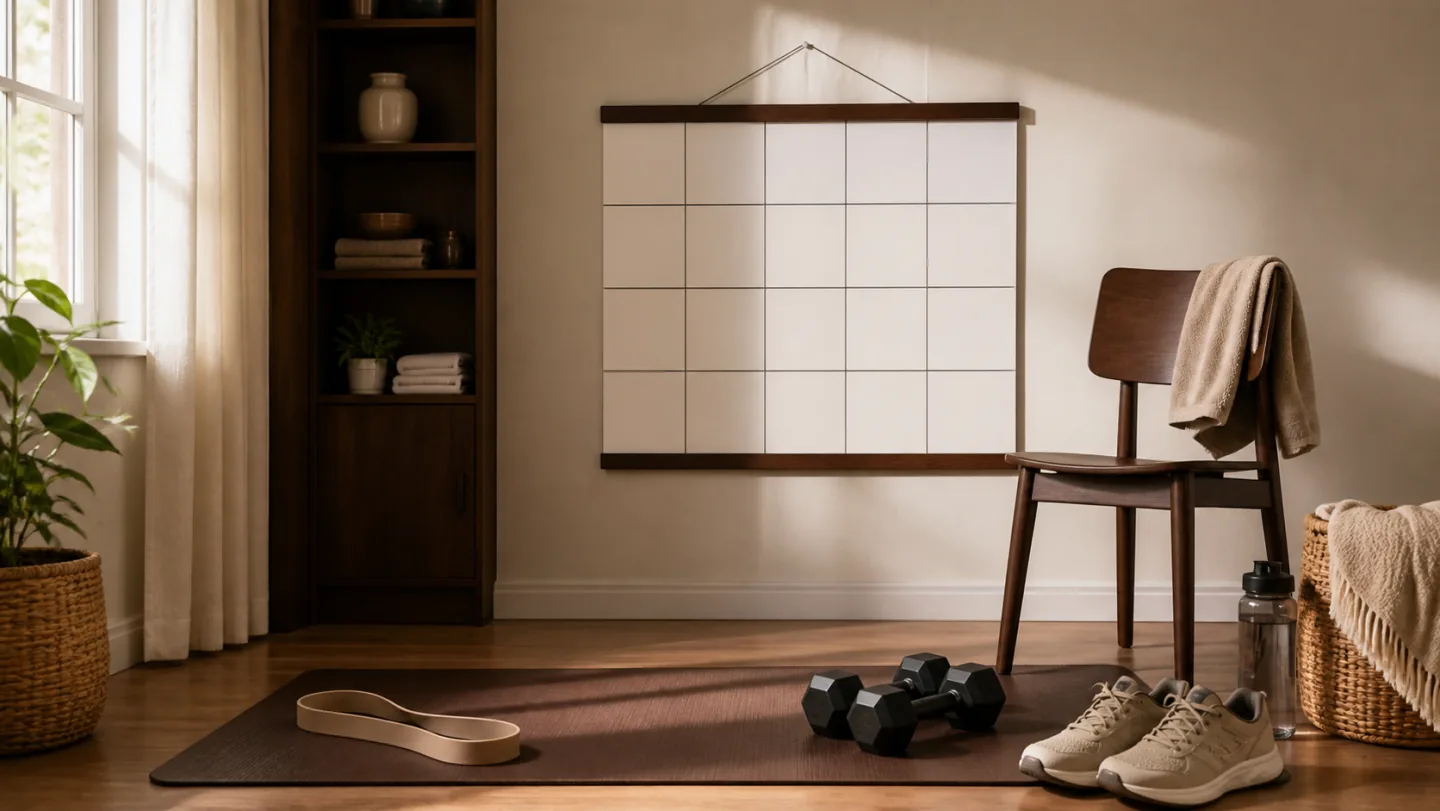
Clear enough floor space to lie down and move your arms. Keep a stable chair, water, supportive shoes, and a notebook nearby. A resistance band or light dumbbells are optional.
The two workouts
Workout A
| Exercise | Amount |
|---|---|
| Chair sit-to-stand | 8–12 repetitions |
| Wall push-up | 6–12 repetitions |
| Hip bridge | 8–15 repetitions |
| Towel isometric row | 15–20 seconds |
| March in place | 60 seconds |
Workout B
| Exercise | Amount |
|---|---|
| Supported reverse step | 6–10 each side |
| Wall hip hinge | 8–12 repetitions |
| Band row or towel row | 8–12 repetitions or 20 seconds |
| Standing wall plank | 15–30 seconds |
| Side steps | 60 seconds |
Your four-week plan
| Week | Strength work | Walking or easy cardio | Goal |
|---|---|---|---|
| 1 | A once, B once, one round | 10 minutes twice | Learn the movements |
| 2 | A once, B once, two rounds | 10–15 minutes twice | Repeat with control |
| 3 | A, B, and optional A, two rounds | 15 minutes twice | Add a few repetitions |
| 4 | A and B, two or three rounds | 15–20 minutes twice | Review your progress |
Leave a day between strength sessions. The CDC recommends muscle-strengthening work on at least two days each week and at least 150 minutes of moderate aerobic activity for adults. That is a public-health target, not a requirement to achieve in your first week. Build toward it from your current level (CDC guidance).
The ten-minute version
On a crowded day, warm up by marching for one minute, then perform one round of the scheduled workout. A shorter session preserves practice without pretending that every day has the same amount of free time.
Soreness and recovery
New exercise can produce muscle tenderness that appears later and improves over several days. Reduce the next session if soreness changes how you move. Sharp pain, swelling, loss of strength, chest symptoms, fainting, or severe breathing trouble require a different response and may need medical care.
Sleep and regular meals support recovery. You do not need a special supplement to complete this month.
Measure progress without a body promise
At the end of each week, review four useful questions:
- Did I complete the planned days?
- Did one movement become smoother?
- Can I do one more controlled repetition?
- Does the same walk feel more comfortable?
Body weight can change for many reasons. It is not the only way to know that your work is helping.
How Rizanah helps
In the Rizanah mobile app, Train shows a weekly workout plan and guides each session. Workout history records completed exercises, sets, repetitions, load, and effort. You can swap an exercise when another available option fits your equipment or health information, and any progression suggestion must be accepted by you before it changes the plan.
Visit Rizanah to find the mobile app for iOS and Android.
The main idea
Use the first 30 days to learn two workouts and make them repeatable. Begin with one round, add a second, and increase only a small part when your movement remains controlled.
This article provides general educational information rather than medical advice.