Explore this article · 8 sections
Modesty does not change how muscles grow, but it can change where, when, and how a woman feels comfortable working out. A useful plan respects both facts. You need progressive resistance, recovery, and enough food, while your clothing, privacy, and environment should fit the standards you follow.
What makes a workout modest?
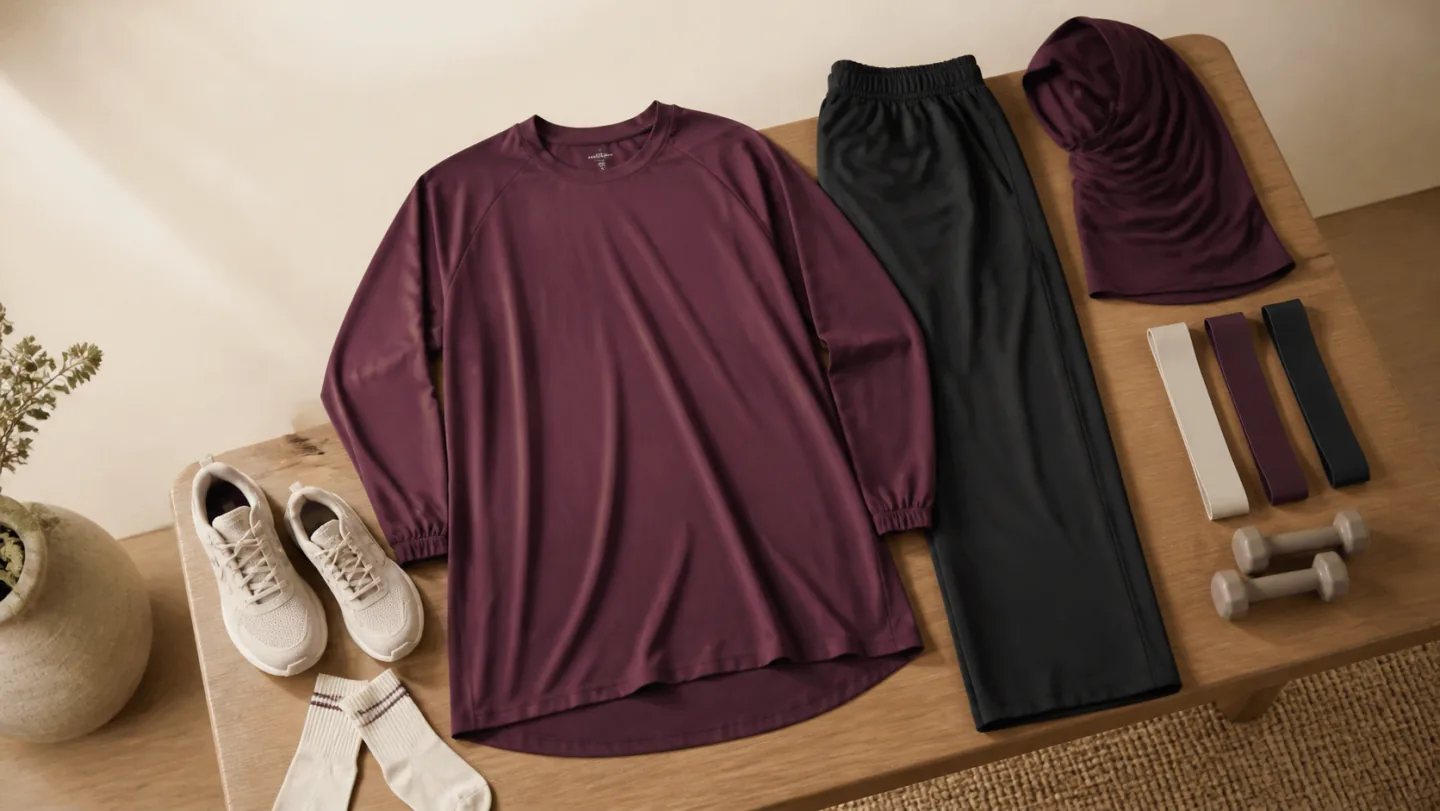
There is no single outfit or room that represents every Muslim woman. Modesty may involve coverage, loose clothing, a women-only space, privacy from cameras, or avoiding mixed settings. Decide your non-negotiables before choosing a gym or class, and ask a qualified scholar when you need a religious ruling.
| Need | Practical option |
|---|---|
| More coverage | Breathable long top, secure hijab, and opaque trousers |
| More privacy | Home workout, women-only hours, or a private studio |
| No public filming | Ask the gym about its camera and social-media policy |
| Prayer access | Choose a location with a clean, quiet space nearby |
Clothing should also move safely. Test a squat, overhead reach, and hip hinge before the workout. Fabric should not catch on equipment, block vision, or make you overheat.
The strength rules that matter
The American College of Sports Medicine recommends working all major muscle groups at least twice each week and building gradually. Its 2026 guidance also says bodyweight, bands, and home routines can work, while complicated methods are optional (ACSM resistance workout guidance).
For each exercise, choose a version you can control. Finish most sets feeling that you could perform about two more good repetitions. When every repetition is smooth, add a small amount of weight, one repetition, or a harder variation.
A two-day full-body workout
Perform these sessions on nonconsecutive days. Begin with one or two sets during week one, then use two or three sets when recovery feels good.
| Day A | Sets × repetitions |
|---|---|
| Goblet squat or chair squat | 2–3 × 6–12 |
| Dumbbell row or band row | 2–3 × 8–12 |
| Incline push-up or chest press | 2–3 × 6–12 |
| Romanian deadlift with dumbbells | 2–3 × 8–12 |
| Farmer carry | 2–3 × 20–40 seconds |
| Day B | Sets × repetitions |
|---|---|
| Split squat or supported lunge | 2–3 × 6–10 each side |
| Lat pulldown or band pulldown | 2–3 × 8–12 |
| Dumbbell overhead press | 2–3 × 6–12 |
| Hip bridge or hip thrust | 2–3 × 8–15 |
| Side plank | 2–3 × 10–30 seconds each side |
Rest until you can perform the next set with control, usually one to three minutes. Longer rest is acceptable for a difficult set.
Home, gym, or women-only studio?
Home offers privacy and removes travel, but equipment and coaching may be limited. A mixed gym may offer more equipment, yet its layout or clothing standards may not suit you. A women-only space can improve comfort, although hours and cost may be less convenient.
Choose the setting you will actually use. Ask about trial visits, women-only hours, window coverings, staff presence, photography rules, and whether men enter for maintenance.
Progress without chasing soreness
Record the exercise, weight, repetitions, and how hard the set felt. Progress can mean a heavier weight, more repetitions with the same weight, better control, or less assistance. Soreness is not required because it mainly reflects a new or unusually stressful demand.
Stop a set when technique changes sharply. Seek medical help for chest pain, fainting, or severe shortness of breath, and get individual guidance for pregnancy, injury, or a medical condition.
How Rizanah helps
Rizanah gives you a workout plan without assuming that every woman wants the same gym setting or exercise. You can follow a structured workout, choose a suitable substitution when equipment or privacy changes, and record the weight and repetitions you completed.
That record matters because strength progress is easy to miss from memory. Rizanah helps you see whether a squat, row, press, or hinge is improving while keeping the focus on capability rather than comparison with another person’s body.
Frequently asked questions
Can I get strong with home workouts?
Yes. Bodyweight, bands, and adjustable dumbbells can provide increasing resistance. A gym becomes useful when you outgrow the resistance available at home or want more exercise choices.
Do women need a different strength plan from men?
The main principles are the same. Individual goals, experience, recovery, pregnancy status, injury history, and preferences matter more than gender stereotypes.
Will lifting make me bulky?
Muscle gain is gradual and depends on workout dose, food, genetics, and time. A beginner does not suddenly become heavily muscular from two weekly workouts.
The main idea
A modest workout is not a weaker workout. Choose a setting and clothing that let you move safely, work each major muscle group twice per week, and increase the challenge little by little. When you are ready to turn the plan into a routine, use Rizanah to follow the workouts and keep each small improvement visible.
This article provides general educational information rather than medical advice or a religious ruling.