Explore this article · 12 sections
- 01Halal and nutritious do not mean the same thing
- 02What should you track first?
- 03When calorie tracking can help
- 04Three levels of nutrition tracking
- 05How to read a food label without getting lost
- 06A full day without obsessive tracking
- 07How to adjust your plan
- 08When tracking becomes harmful
- 09A simple system you can begin today
- 10How Rizanah helps
- 11Frequently asked questions
- 12The main idea
Halal nutrition tracking asks two different questions: Is this food permissible, and does it help meet your body's needs? A halal label can answer part of the first question, but it does not tell you whether a meal has enough protein, fiber, vitamins, or energy for your goals.
You do not have to count every calorie to eat well. A useful system can be as simple as checking whether food is halal, building balanced meals, and watching patterns over time.
Halal and nutritious do not mean the same thing
Halal describes whether a food and its preparation meet Islamic requirements, while nutrition describes what the food provides to your body. A food can be halal and still be low in nutrients, just as a nutritious-looking product can contain an ingredient that a Muslim wants to verify.
The Codex Alimentarius Commission, the food-standards body run by the United Nations Food and Agriculture Organization and the World Health Organization, specifically warns against presenting halal food as automatically safer or more nutritious than other food (Codex halal guidelines).
This means a useful food check has two lanes:
| Halal check | Nutrition check |
|---|---|
| What are the ingredients? | Does the meal contain useful nutrients? |
| Is certification present when needed? | Does it support my health and workout goals? |
| Could processing or preparation change the ruling? | Is the portion enough, too little, or more than I need? |
| Do I need guidance about a disputed ingredient? | How does this fit with the rest of my week? |
Keeping these questions separate prevents a common mistake: treating halal certification as a health score.
What should you track first?
Start with the information that can change a decision. For most people, four layers are enough.
1. Check whether the food is halal
Place food into a simple confidence level:
- Clear: Whole plant foods, clearly permissible ingredients, or a trusted halal certification.
- Check: Flavorings, gelatin, enzymes, emulsifiers, meat sources, or restaurant preparation that needs more information.
- Avoid: A clearly prohibited ingredient or a product that does not meet the standard you follow.
Do not turn every unfamiliar chemical name into a danger signal because many long ingredient names come from plants, minerals, or fermentation. Check the source when the source matters, and use a qualified scholar or recognized certifier for religious questions that remain unclear.
2. Meal balance
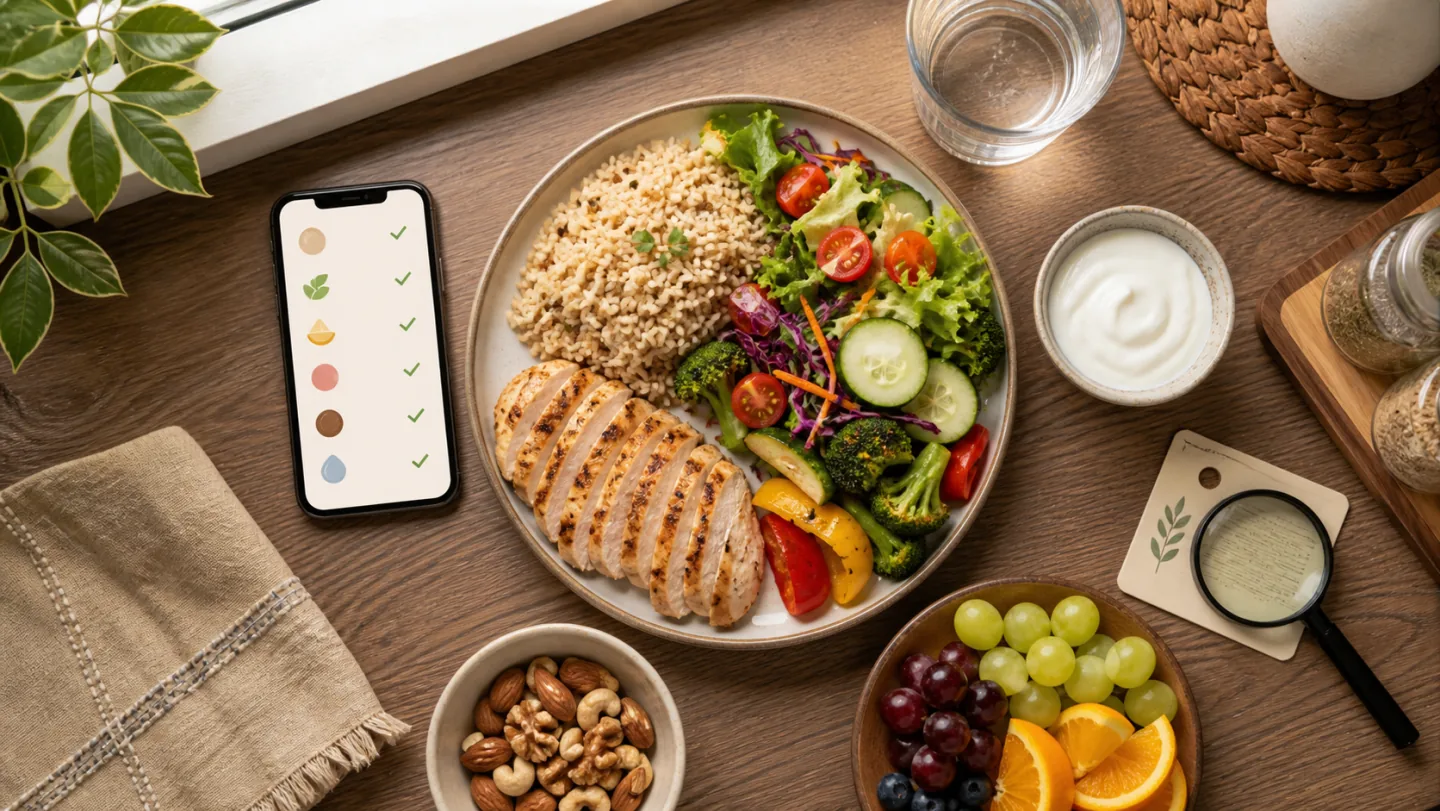
A balanced meal does not require perfect measurements. As a starting point, build most meals from:
- A protein source
- A fruit or vegetable
- A grain, potato, or other carbohydrate source
- A source of dietary fat
- Water or another suitable drink
The USDA MyPlate model uses food groups rather than calorie counting and encourages variety across fruits, vegetables, grains, protein foods, and dairy or fortified soy alternatives. Its protein group includes meat, poultry, seafood, eggs, beans, lentils, nuts, seeds, and soy foods (MyPlate protein foods).
This framework works with many cuisines, including lentil soup with bread and salad, chicken biryani with vegetables and yogurt, tofu with rice and greens, or eggs with oats and fruit.
3. Protein
Protein supports muscle repair and many normal body functions. People who work out regularly may need more than sedentary adults, but more is not always better.
The International Society of Sports Nutrition states that about 1.4 to 2.0 grams of protein per kilogram of body weight per day is sufficient for most exercising adults who want to build or maintain muscle (ISSN position stand). This range is not a personal prescription, and people with kidney disease or other medical concerns should seek individual guidance.
For a 70-kilogram adult, the range would be:
| Calculation | Daily amount |
|---|---|
| 70 × 1.4 | 98 grams |
| 70 × 2.0 | 140 grams |
A beginner does not need to aim at the top of the range. A simpler first step is to include a meaningful protein source at each main meal, then measure only if progress or recovery suggests a need.
4. The weekly pattern
One meal rarely defines a diet, so look at the pattern across a week. Ask whether you regularly eat a variety of foods, get fruits and vegetables, drink enough fluid, and have energy for daily life and workouts.
Healthy dietary patterns are designed to provide food groups and nutrients while remaining within energy needs, according to the Dietary Guidelines for Americans. That broader pattern matters more than making every plate look perfect.
When calorie tracking can help
Calories describe energy, and tracking them can help when someone has a specific goal, such as understanding portions, gaining weight, losing weight, or supporting demanding workouts. A short tracking period can also reveal patterns that are difficult to see from memory.
Calorie tracking is less useful when the database is inaccurate, portions are guessed, restaurant meals are treated as exact, or the numbers create anxiety. Even a carefully logged total remains an estimate because food labels, recipes, and individual energy needs vary.
Use calorie tracking as a measurement tool rather than a grade. If the number helps you make a decision, keep it; if it only produces guilt, choose a simpler method.
Three levels of nutrition tracking
Choose the lightest level that gives you enough information.
Level 1: The meal check
At each main meal, record only four checks:
- The food is clearly halal
- Protein is present
- A fruit or vegetable is present
- The portion leaves you comfortably satisfied
This level works well for beginners and people who dislike numbers.
Level 2: Protein and portions
Track your protein sources and use repeatable portions for the rest of the meal. For example, use the same bowl for rice, the same spoon for oil, or the same container for lunch. Consistency makes changes easier without requiring exact calorie totals.
This level can support general fitness, better meal planning, and early muscle-building goals.
Level 3: Calories and macros
Track calories, protein, carbohydrates, and fat when your goal requires more precision. Weighing food for one or two weeks can teach you what portions look like, but you may not need to weigh food forever.
Experienced lifters may use this level during a focused muscle-gain or fat-loss phase, then return to a lighter system during maintenance.
How to read a food label without getting lost
Use this order:
- Check the serving size. All nutrition numbers refer to that amount.
- Read the ingredient list. Ingredients appear from greatest to smallest amount by weight.
- Look for halal certification when it matters. Certification is especially useful for meat and complex processed foods.
- Check protein, fiber, added sugar, saturated fat, and sodium based on your needs. No single number decides whether the entire food is good or bad.
- Investigate only ingredients that require it. Gelatin, animal enzymes, certain emulsifiers, alcohol-containing flavor systems, and meat sources may deserve a closer look.
Standards and scholarly interpretations can differ by country and school of thought. A nutrition app can organize information, but it should not pretend to settle every religious disagreement.
A full day without obsessive tracking
Here is a simple example for an adult who works out recreationally. Portions should change with body size, appetite, goals, health needs, and activity.
| Meal | Example | What it provides |
|---|---|---|
| Breakfast | Oats, milk or fortified soy drink, berries, and eggs | Carbohydrate, protein, fiber, and micronutrients |
| Lunch | Halal chicken or chickpeas, rice, mixed vegetables, and yogurt | Protein, carbohydrate, produce, and calcium |
| Snack | Fruit with nuts, or yogurt with fruit | Energy, fiber, and protein depending on the choice |
| Dinner | Salmon, tofu, or lentils with potatoes and salad | Protein, carbohydrate, produce, and dietary fat |
This day is not a universal meal plan. Its value comes from the repeatable structure because each meal answers a clear need without requiring constant calculation.
How to adjust your plan
Use two to four weeks of information before making a major change unless a health professional tells you otherwise.
- If workout performance and recovery are poor, check total food, carbohydrates, protein, fluids, and sleep.
- If you are always hungry, add filling foods such as vegetables, fruit, beans, whole grains, and protein.
- If your goal is muscle gain and your weight is not changing, add a repeatable portion to one or two meals.
- If your goal is gradual fat loss and nothing changes, reduce a repeatable portion rather than removing entire food groups.
- If energy, mood, menstrual health, digestion, or your relationship with food worsens, stop tightening the plan and seek qualified help.
Body weight can change from water, salt, stored carbohydrate, digestion, and menstrual-cycle shifts, so one weigh-in should not control your next decision.
When tracking becomes harmful
Tracking should make food decisions easier. It may be doing the opposite if you avoid meals with family, fear food you cannot measure, repeatedly lower your target, ignore hunger, or feel that exceeding a number makes you a bad person.
People with a current or previous eating disorder should discuss tracking with an appropriately qualified clinician. You can support health without recording calories or body weight.
A simple system you can begin today
For the next seven days, record only:
- What you ate
- Whether the food is clearly halal or needs checking
- The main protein source
- Whether a fruit or vegetable was included
- How your energy felt before your next meal
At the end of the week, choose one change that would make the next week easier. You might prepare a protein source, buy frozen vegetables, check a product's certification, or pack a reliable snack.
How Rizanah helps
Generic calorie trackers usually treat food as a set of numbers. Rizanah is designed to keep those nutrition estimates beside halal food information, recipes, meals, and the workout goal the food is meant to support. That means a user can check whether an ingredient needs attention, build a balanced meal, and see how it fits the wider plan without moving between disconnected apps.
Rizanah also lets you begin with useful information rather than demanding maximum detail. Save repeatable meals, track protein or portions when they answer a real question, and connect the result to workout progress. The app should remain honest when a restaurant portion or disputed ingredient cannot be known with certainty.
Frequently asked questions
Do I need to count calories to eat well?
No, many people can support their health with balanced meals, repeatable portions, and attention to hunger, energy, and weekly patterns. Calorie tracking is optional and works best when it answers a specific question.
Is every vegetarian food halal?
Not automatically, because alcohol, processing aids, flavorings, cross-contact, or other ingredients may still matter. Whole plant foods are generally straightforward, while processed products may need a label check.
Does halal food help with weight loss?
Halal status does not guarantee weight loss or nutritional quality. Weight change depends on many factors, including overall energy intake, activity, sleep, medication, health conditions, and time.
Should I track macros or only protein?
Start with protein and meal structure if those provide enough direction. Add calories, carbohydrates, and fat when a clear performance or body-composition goal requires more detail.
How exact does my food log need to be?
It only needs to be accurate enough for the decision you are making. A general wellness log can use meal descriptions, while a focused performance phase may benefit from measured portions.
The main idea
Halal nutrition tracking is not a contest to collect perfect numbers because its purpose is to help you choose permissible food, meet your body's needs, and notice patterns you can improve. Track the least amount of information that helps you make a useful decision, then let consistency do more work than precision. Rizanah brings the halal check, nutrition record, recipes, and workout goal together when you want one place to manage the whole pattern.
This article provides general educational information rather than medical advice or a religious ruling. Discuss individual health and religious questions with appropriately qualified professionals.