Explore this article · 11 sections
- 01Key facts
- 02Do you need protein powder at all?
- 03Whey, casein or plant?
- 04The ingredients that make a powder doubtful
- 05How to verify a halal claim
- 06Reading the rest of the label
- 07Quality testing is a separate question
- 08Comparing prices honestly
- 09How Rizanah helps
- 10Frequently asked questions
- 11The main idea
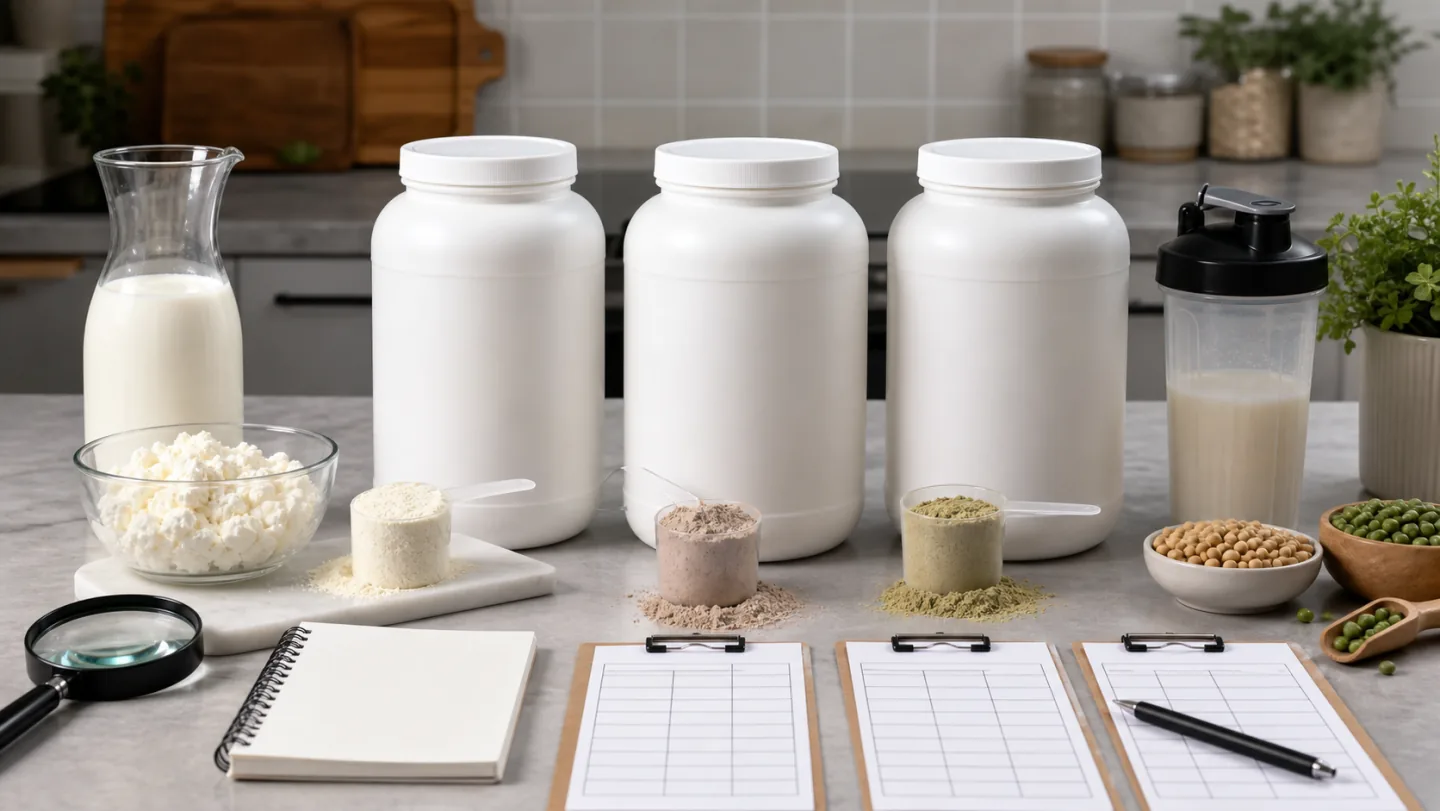
The best halal protein powder is not a brand. It is whichever tub in front of you passes five checks today: the exact product is halal certified, the protein source and dose fit you, nothing in the ingredient list is unresolved, an independent lab has tested it recently, and the price per useful serving makes sense. Brands change factories, formulas and certifiers without telling anyone, so a list of names goes stale within a year. A method does not.
This guide gives you that method. It covers whey, casein and plant powders, what in them can be doubtful, how to read the label and the certificate, and how to compare prices honestly. If your question is narrower, we have separate answers for whether whey protein is halal and whether creatine is halal.
Key facts
| Question | Short answer |
|---|---|
| Is protein powder halal? | Often, but it has to be checked product by product |
| What can make it doubtful? | Enzymes in whey, gelatin, glycerin, alcohol-based flavors, unnamed "natural flavors" |
| What proves it? | The exact product in a certifier's current directory, or the certifier's mark on the tub you hold |
| Do you need it? | No. Food can cover protein. Powder is a convenience |
| How much protein per day? | Roughly 1.4 to 2.0 grams per kilogram of body weight for people who work out |
| What to compare | Price per 25 grams of protein, not price per tub |
Do you need protein powder at all?
No. Chicken, eggs, fish, yogurt, lentils and beans can cover a lifter's protein without a scoop in sight. Powder earns its place when cooking, appetite, travel, cost or a fasting schedule makes a regular meal hard to fit in. A scoop in water after a late workout is easier than a chicken breast at eleven at night.
The daily range most exercising adults land in is about 1.4 to 2.0 grams of protein per kilogram of body weight, according to the International Society of Sports Nutrition's position stand (ISSN protein position stand). For a 70 kilogram person that is roughly 100 to 140 grams a day. Count what your meals already give you before deciding how much a powder needs to add. Most people need one scoop a day at most, and plenty need none.
Whey, casein or plant?
| Type | What it is | Protein per 30 gram scoop | Halal questions to resolve |
|---|---|---|---|
| Whey concentrate | The liquid left from cheese making, filtered and dried | About 22 to 24 grams | The enzyme used to make the cheese, plus flavors and emulsifiers |
| Whey isolate | Whey filtered further, less lactose and fat | About 25 to 27 grams | Same as concentrate |
| Casein | The other milk protein, slower to digest | About 24 grams | Same as whey |
| Pea, rice, soy, hemp and blends | Plant proteins, often blended to round out amino acids | About 20 to 25 grams | Flavors, sweeteners, any added vitamins made with gelatin carriers |
| Beef or collagen | Protein from hide or bone | Varies | The animal's slaughter, and collagen is not a complete protein for muscle |
Whey is the most studied and the most common, and it is also the one with the most frequent halal question. Whey is a by-product of cheese, and cheese is made with an enzyme called rennet. Rennet can come from a calf's stomach, from a halal-slaughtered or non-halal animal, or from microbes and plants. The milk is fine either way. The enzyme is the question, and the tub almost never names it. That is why whey needs a certifier rather than a guess.
Plant powders avoid the rennet question entirely, which is why many people choose them. They still carry flavor and sweetener questions, and a pea protein on its own is lower in one amino acid, leucine, than whey, so blends and slightly larger servings close the gap.
Collagen powders are popular, but collagen is not a complete protein and should not be counted as your main source for muscle. Our guide to halal protein sources explains why.
The ingredients that make a powder doubtful
The protein itself is rarely the problem. The small print is. IFANCA, one of the main halal certifiers in the United States, lists whey and several common supplement ingredients among items whose source may need review (IFANCA Halal Shopper's Guide). On a protein tub, look for these:
- Enzymes in whey and casein, as explained above.
- Gelatin, in any capsule, gummy or some "protein" snacks, and occasionally as a carrier in vitamin blends added to powders.
- Glycerin and mono- and diglycerides, emulsifiers that can be plant or animal derived.
- Natural flavors, a legal catch-all that can hide animal-derived or alcohol-carried components.
- Alcohol-based flavor extracts, more common in liquid products and some "bakery" flavors.
- L-cysteine, sometimes used in flavor systems, which can be animal derived.
- Stearates, in tablets more than powders, but worth a glance.
Lecithin, the most common emulsifier, is usually from soy or sunflower and is not a concern. Sweeteners such as sucralose, stevia and acesulfame potassium are not a halal concern either, whatever you think of their taste.
An ingredient on this list is not a verdict. It is a question that has to be answered by the manufacturer or the certifier before you buy. Do not award yourself partial certainty. Either the question gets resolved or you choose a different tub.
How to verify a halal claim
There is an order of evidence, and most buying mistakes come from stopping too early in it.
- The exact product is in the certifier's current directory. Name, flavor and size. This is the strongest evidence, because the certifier maintains it and you can check it without trusting a photo.
- The certifier's mark is on the package you are holding. Good, provided the mark belongs to a real certifier and the tub is the same product sold in your country.
- The certificate itself, naming the product, the factory, the region and its valid dates. Ask for it if the directory does not list the product.
- A manufacturer statement that the product is halal. Useful for answering an ingredient question, but it is not certification and it is the weakest of the four.
A few habits make this reliable:
- Check the tub, not the brand. A company's certified unflavored whey says nothing about its cookies-and-cream flavor, and the version sold in the Gulf may come from a different factory than the one sold in Birmingham.
- Date your check. Formulas and certificates change. If you buy the same tub for a year, look it up again when the packaging changes.
- Treat marketplace listings with care. Online listings can merge several sellers' stock and photos. Compare the delivered tub with what you researched, check the seal and the lot number, and send it back if the label does not match.
- Ask a precise question. "Is this exact product, flavor and size currently halal certified for sale in my country, by which certifier, and where can I verify it?" Save the dated reply.
The certifiers you will see most often are IFANCA, ISA and HFSAA in the United States, HMC and HFA in the United Kingdom, JAKIM in Malaysia, MUI in Indonesia and ESMA in the Emirates. Any of them beats a crescent printed by the brand itself.
Reading the rest of the label
A supplement label cannot prove halal status on its own, but it tells you what questions to ask. Read five parts: the product identity, the serving size and servings per container, the Supplement Facts or nutrition panel, the "other ingredients" list, and the manufacturer and lot details.
Two things to know about the rules behind that label. In the United States, the FDA requires the facts panel and ingredient list but does not approve supplements for safety or effectiveness before they are sold (FDA 101: Dietary Supplements). And a "proprietary blend" is allowed to show one total weight for several ingredients without listing each amount, which makes dose impossible to judge. Prefer powders that state every amount.
Quality testing is a separate question
Halal certification and quality testing answer different questions, and a tub can pass one and fail the other. Independent programs such as Informed Sport, Informed Protein, NSF Certified for Sport and USP Verified test for contaminants, banned substances or label accuracy, depending on the program. Look the product up on the testing organization's own website rather than trusting a logo in a product photo. If you compete in a tested sport, this is not optional.
Comparing prices honestly
Price per tub tells you nothing. Divide the price by the number of servings, then adjust for how much protein each serving actually delivers. A cheaper tub with a small scoop can cost more per 25 grams of protein than a dearer one.
Worked example: a tub priced at 40 with 30 servings of 24 grams of protein costs 1.33 per serving, or about 1.39 per 25 grams of protein. A tub priced at 30 with 25 servings of 18 grams costs 1.20 per serving but 1.67 per 25 grams. The cheaper tub is the dearer protein. Add shipping and read the subscription terms before you decide.
How Rizanah helps
In the Rizanah app, the Nutrition tab shows your protein for the day alongside the rest of your meals, so you can see whether a scoop is filling a real gap or just adding calories. Supplements, under Settings, lets you save a supplement by name with an optional dose and tick it off each day. Rizanah does not verify any product's halal status, certification, safety or effectiveness. That check belongs with the certifier, the manufacturer, the testing body and, for health questions, a pharmacist or clinician.
Visit Rizanah to find the mobile app for iOS and Android.
Frequently asked questions
Is whey protein halal?
It can be. The milk is not the issue. The enzyme used in the cheese making that produces whey can be animal derived, so whey needs the finished product to be certified or the manufacturer to confirm a microbial or halal enzyme. Our full answer on whey goes through it label by label.
Is plant protein automatically halal?
The protein is, but the finished powder still carries flavors, sweeteners and sometimes vitamin blends that need checking. Certification is still the cleanest answer.
Which halal protein powder is best?
The one that passes the five checks for the tub you can actually buy in your country today. We do not keep a brand list because brands change formulas and certifiers faster than an article can be updated.
Is a halal logo on the tub enough?
Only if it belongs to a real certifier and the product is in that certifier's directory. A crescent the brand drew itself is a claim, not evidence.
How much protein powder should I take?
Enough to reach your daily total and no more. For most people that is one scoop on days when meals fall short, and none on days when they do not.
The main idea
Choose with a dated checklist, not a brand list: the finished product is certified, the protein source and dose fit you, every ingredient question is resolved, the quality test is current, and the price per gram of protein is honest. Then stop thinking about it and get back to your workouts.
Product formulas and certifications change. Verify the current package before purchase. This article provides education, not a religious ruling or medical advice.